
Lighting Control Developments
An overview of lighting control technology.
THIS PAGE IS UNDER CONSTRUCTION - COME BACK SOON
Evolution of Lighting Control
Pre-electricity
Direct Dimmer Control
Remote Control
Strand Light Console - coming soon
Memory Consoles
Punched Cards
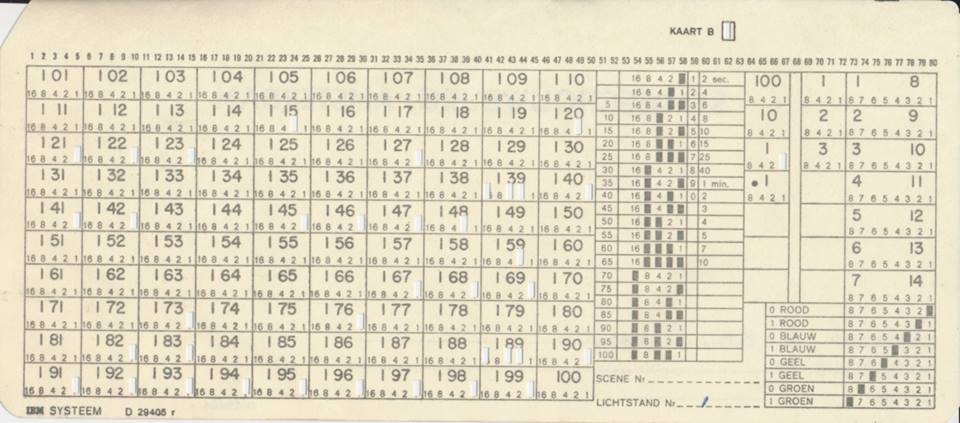
In the early days of computing, the technology of hard disks and re-writable memory cards did not exist, so in order to 'memorise' lighting states, punched cards were used, which were then fed into the lighting computer in order, to recall the cue. Mechanical pins 'read' the information from the card on insertion, which was then made into the current lighting state on command. The cards for the next state were then inserted.
The card shown below is from a lighting control desk in the Amsterdam Municipal Theatre (Stadsschouwburg) and was in use in the 1970s and 1980s.
Each lighting state (cue) used two cards, one for channels 1-100, the second for 101-200. The levels for each channel were encoded in 5% increments (so only 25% or 30% were possible, not 28%).
Columns 64-67 were used to encode the cue number. Columns 69-72 encoded the crossfade time, and columns 73-80 were used to control the mechanical colour changers (most likely semaphore type) in some FOH positions.
Many thanks to Roderick Van Gelder for posting this information.
Multiplexed Signal - Analogue
This was the first step towards the lighting control protocol we use today. Rather than wire-per-dimmer systems, which rely on a huge amount of expensive copper wiring from the control desk to the dimmers, making it difficult and time-consuming to move the desk for a complex system, a multiplex system is a serial system of communication - control levels are sent down a single cable, in a repeating sequence of channel numbers.
A serial stream of (originally) analogue voltages with strict timing separations which enabled a de-multiplexing ('demux') microprocessor interface to 'decode' the signal and allocate the different voltages to a specific lighting channel.
In the USA, Strand Lighting developed AMX192 (US Standard, introduced around 1975, known as AMX) could control up to 192 channels and used a 4-pin XLR connector. (AMX stands for Analogue Multiplex). Later desks were able to support multiple streams of AMX to increase the number of channels supported. The protocol used a separate clock pulse generator which ran in each device that used AMX.
Around the same time in the UK, Strand developed D54 protocol which was similar to AMX192, but was able to carry up to 384 voltage values for that many channels, along with a more strict clock pulse, embedded within the control signal, to keep the desk and dimmers synchronised properly. D54 used a 3-pin XLR connector.
Both AMX192 and D54 have now largely been replaced by the universally used digital protocol USITT DMX512 (see below).
Digital Control (DMX512)
Officially known as USITT DMX512 but often shortened to DMX, this protocol was introduced in 1986, and is based on the RS485 data standard. Most professional lighting desks use 5-pin XLR connectors, but cheaper equipment and many moving lights or LED fittings use the cheaper 3-pin XLR connector, although this is not supported in the USITT standard.


Wiring for DMX512
| Pin number | 1 | 2 | 3 | 4 | 5 |
| 3 pin XLR | Shield | negative | positive | // | // |
| 5 pin XLR | Shield | negative | positive | NC | NC |
(NB: The shield should not be connected to the body of the connector. NC = Not Connected)
Evolution
As technologies change, new protocols (or new versions of existing protocols) are introduced:
SMX is a communications protocol which enables digital dimmers to "report back" to the desk on any faults (eg blown lamps).
DMX512-A (officially ANSI E1.11) is a new standard under development at ESTA which is backwards compatible with DMX512 but has stricter safety parameters and offers some upgrades of functionality.
RDM (Remote Device Management)
RDM is an emerging upgrade to DMX512 which will include bi-directional communication between controller and device. It's officially known as ANSI E1.20, Remote Device Management.
As well as controlling devices, it also allows remote configuration of instruments. This could include basic setup such as setting start addresses (which could be done automatically by a computerised system; this alone could save hours).
Although manufacturer uptake is limited so far, it's hoped this situation will change soon.
Software-configurable lighting control desk
The industry-standard theatre desk in the UK for many years was the 500 series by Strand Lighting. Used on shows large and small, it was based around a low-specification PC running a modified version of Microsoft's DOS language. Almost every function on the desk can be configured, and by updating the operating system, a completely new set of functions can be added.
Moving Light Control